
Indonesia's free meal kitchens are being designed into the circular economy, kitchen by kitchen
By Sirkularium Editorial Team, 8 min read
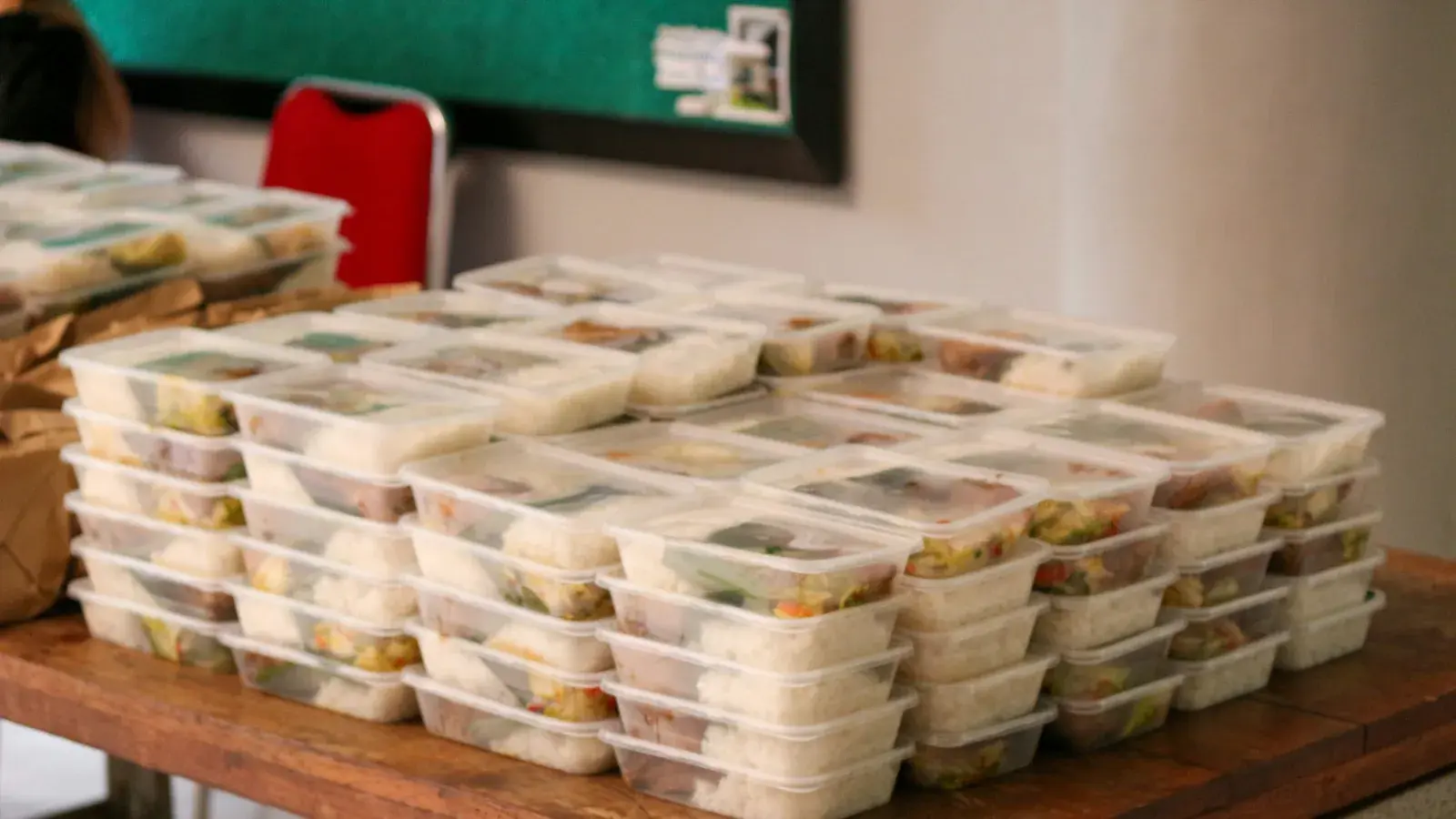
The Ministry of Environment confirmed on 3 August 2026 that it will guide Satuan Pelayanan Pemenuhan Gizi kitchens under the free nutritious meal programme toward closed loop operation, covering food scraps, used cooking oil and treated water. With 28,390 kitchens already running and food scraps making up 40.77 percent of national waste composition, the programme becomes one of the largest organic streams Indonesia can design for from the start.
A national programme and a national waste target meet in the kitchen
On 3 August 2026 the Ministry of Environment and Environmental Control Agency confirmed that it stands ready to accompany Satuan Pelayanan Pemenuhan Gizi units, the kitchens that deliver Indonesia's free nutritious meal programme, as they move toward circular operation. Deputy Minister of Environment Diaz Hendropriyono, who also serves as deputy head of the Environmental Control Agency, put the question in operational terms. The issue is not whether a kitchen can clean up after itself, but whether the production process can be circular in the first place.
The timing matters. Indonesia halted open dumping at final processing sites from 1 August 2026, and cities across the country now accept only residue at their landfills. Every stream that can be closed upstream reduces the volume that has to be handled downstream. The meal programme is one of the largest and most uniform organic streams the country has, and it is young enough to be designed rather than retrofitted.
That is the central opportunity. Most waste systems in Indonesia are being reformed after decades of collect, transport and dispose habits. The kitchens of the meal programme are new infrastructure. Their material flows can be specified before those habits set.
The scale of the organic stream
The programme is now substantial. By 13 May 2026 the Government Communications Agency recorded 61,991,412 registered beneficiaries, or 74.8 percent of the 82.9 million target, served by 28,390 operating kitchens. Of those, 15,795 kitchens, or 55.42 percent, had secured hygiene certification. The National Nutrition Agency has continued to expand the network through 2026.
Each of those kitchens produces material every day. In Brebes Regency, Central Java, the National Nutrition Agency coordinator Arya D. Nugroho reported that 203 operating units, drawn from 226 partner kitchens, generate roughly one quintal, or 100 kilogrammes, of material per kitchen per day. Across the regency that reaches about 20 tonnes daily. Multiply that pattern across a national network approaching 30,000 kitchens and the arithmetic becomes clear without any need to exaggerate it.
The national context reinforces the point. Ministry of Environment data compiled through the national waste information system for 2025 shows food scraps at 40.77 percent of composition, ahead of plastic at 20.52 percent, wood and branches at 13.13 percent, and paper and cardboard at 11.4 percent. Organic material is already the single largest fraction of what Indonesian cities handle. A programme that concentrates organic material in fixed, identifiable, professionally staffed locations offers something the household stream cannot: predictability.
The rules are already written
The regulatory groundwork is in place. Peraturan Badan Gizi Nasional Nomor 1 Tahun 2026 requires kitchens to manage waste comprehensively, from planning through implementation, monitoring and reporting, with circular economy principles at the front. In practice that means identification, separation at source, composting facilities and black soldier fly cultivation, together with regular documentation of volume by type.
The head of the National Nutrition Agency, Dadan Hindayana, described the intent behind the regulation in plain terms.
Waste is no longer viewed as a final discard, but as a resource that still holds usable value.
Water carries its own framework. Keputusan Menteri Lingkungan Hidup Nomor 2760 Tahun 2026 sets quality standards and treatment technology for kitchen effluent, and the ministry has published basic engineering design guidance sized at 10 cubic metres per day. Tulus Laksono, Director of Water Protection and Quality Management at the ministry, has framed the requirement as a matter of delivering the programme's benefit whole: nutrition for children, and clean water for the communities around each kitchen.
Two ministries, one agency and a single set of documents therefore already point in the same direction. What remains is implementation support, which is precisely what the ministry offered on 3 August.
What a closed loop looks like in practice
The clearest illustration is at SPPG Halim in Jakarta. Effluent from food production passes through a treatment installation and is then used to irrigate 6.5 hectares of adjacent rice fields. Those fields now yield three harvests a year. The kitchen's water leaves as an agricultural input rather than a discharge, and the surrounding farmers gain a reliable dry season supply.
Other sites show different loops. In Gorontalo and in Labuan Bajo, East Nusa Tenggara, residual food is directed to animal feed and used cooking oil is collected for recycling rather than entering drains. Each of these is a modest, replicable arrangement rather than a large capital project.
The target is that we accompany these units so that each one can build a circular ecosystem around itself.
That framing, from the deputy minister, is worth noting for what it does not assume. It does not require every kitchen to install identical equipment. It asks each kitchen to find the local partner, whether a farmer, a livestock keeper, a waste bank or a collector, who can take what it produces.
Brebes shows the district level mechanics
The Brebes experience is instructive because it moved from measurement to structure. A pilot in Losari sub district separated the material into two categories and found that 79 percent was preparation residue, the egg shells, banana peels and bones that were never going to be eaten, while 21 percent was food left in containers after service.
That split is operationally significant. Preparation residue is generated in the kitchen, before service, in a known place at a known time, and it is clean and uniform. It is close to ideal feedstock for composting and for black soldier fly cultivation. The smaller post service fraction is the part that responds to portioning, menu design and distribution timing.
Brebes then built an institution around the finding, establishing the Forum Mitra Ketahanan Gizi to coordinate handling across the regency's kitchens. Measurement first, then a body to act on it, is a sequence other regencies can copy at low cost.
Sirkularium's view for government and public institutions
Three observations follow for policy, financing and implementation.
First, the meal programme should be treated as circular economy infrastructure in its own right, not only as a nutrition programme with a waste annex. Its kitchens are fixed, mapped, staffed and already reporting. That makes them the most tractable organic collection points a regency has. Regional environment agencies that integrate kitchen data into their waste planning gain a reliable baseline that the household stream rarely provides.
Second, the binding constraint is offtake, not regulation. Compost, larvae biomass, animal feed and treated water all need a receiving party. Regencies that pre arrange those relationships, as Brebes has begun to do, convert an operating cost into a local input. Where farmer groups, waste banks or livestock cooperatives already exist, the connection cost is small.
Third, measurement should come before equipment. The Losari finding that roughly four fifths of the material is preparation residue changes what a kitchen needs to buy. A regency that measures its own split first will size its composting and larvae capacity correctly rather than by assumption.
What to watch next is the pace at which the ministry's accompaniment reaches beyond the pilot sites at Halim, Gorontalo and Labuan Bajo, and whether the reporting required under the National Nutrition Agency regulation begins to produce a national picture of kitchen organic volumes. If it does, Indonesia will hold something valuable: a clean, current, nationally consistent dataset on its largest waste fraction, generated as a by product of feeding its children.
National waste composition, 2025
Values in percent
Sources
- Antara News, KLH siap dampingi SPPG MBG terapkan ekonomi sirkular
- Beritalima, Wamen LH: KLH/BPLH berkomitmen dampingi program MBG terapkan prinsip sirkularitas
- Kompas, BGN wajibkan SPPG kelola sampah MBG secara ekonomi sirkular
- Kementerian Lingkungan Hidup, Jaga Gizi, Jaga Lingkungan: KLH/BPLH kawal pengelolaan air limbah SPPG
- Kompas, Sampah dapur MBG Brebes tembus 20 ton per hari
- Kompas, Bakom sebut 61,9 juta orang jadi penerima manfaat MBG
- GoodStats Data, Komposisi sampah nasional 2025 berdasarkan SIPSN