
Kebon Talo gives 60 tonnes of Mataram's daily waste a route into recovered fuel
By Sirkularium Editorial Team, 9 min read
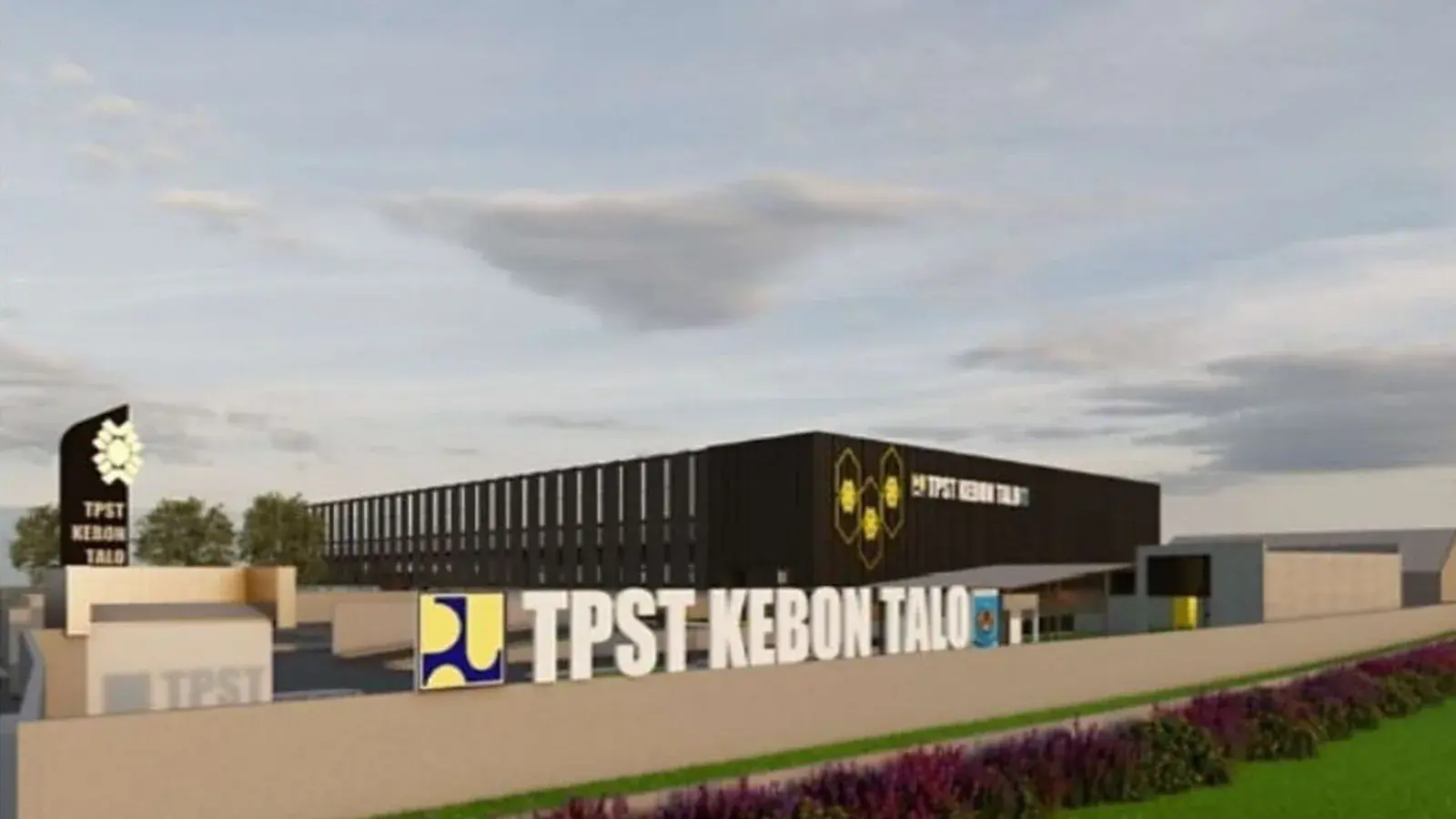
Public Works Minister Dody Hanggodo reviewed the TPST Kebon Talo project in Mataram on 9 August 2026. The Rp97 billion facility, due for completion on 31 December 2026, will sort 60 tonnes of waste a day on a 1.48 hectare site and convert the combustible fraction into solid recovered fuel.
Mataram now has a dated, costed and physically visible answer to the question of where its household waste goes next. On Sunday 9 August 2026, Minister of Public Works Dody Hanggodo reviewed construction of the integrated waste processing facility at Kebon Talo, in Ampenan, Mataram City, West Nusa Tenggara. The plant is being built by the central government, is scheduled for completion on 31 December 2026, and is designed to take 60 tonnes of waste a day out of the disposal stream and put it through a sorting and fuel recovery line instead.
The significance is less in the tonnage than in the design intent. Kebon Talo is not a transfer station with a longer conveyor. It is a facility whose output is meant to be a product with a buyer.
What the Ministry of Public Works is building at Kebon Talo
The facility occupies 1.48 hectares. The core of it is a processing hall of 2,592 square metres, supported by an operations centre, a weighbridge operator post, a control room and a powerhouse. Physical construction began on 12 June 2026. The design service life is 20 years.
Inside, waste moves through an automated sorting system that separates the organic fraction, inorganic materials, metals and residue. From there it splits into two lines. The organic line handles the wet fraction. The second line prepares the dry combustible fraction as solid recovered fuel, the more tightly specified cousin of refuse derived fuel. Earlier reporting on the project described the thermal step as a dry jet process based on heating rather than open combustion.
In service terms, Kebon Talo is assigned to Kecamatan Ampenan and Kecamatan Sekarbela. That is a defined catchment rather than a citywide promise, which matters for how the city plans collection routes around it.
Minister Dody framed the plant as one step in a longer sequence, and paired the technical ambition with a behavioural one.
In future we will turn these mountains of waste into electricity. But more important than that, we first change our own habits.
He also used the visit to press a simple message on disposal into rivers and the sea, and placed the project within the President's direction to accelerate waste handling through stronger infrastructure and technology that treats waste as a resource with value.
The numbers behind the plant, and where they differ
Construction is funded by the central government at Rp97 billion. Operations are a separate line item and a local one. Mataram City Government would need to budget roughly Rp5.4 billion a year to run the facility once it is handed over, a figure given by the head of the Mataram City Environmental Service, H. Nizar Denny Cahyadi, in July 2026.
That split is worth stating plainly because it is the part most often left out of announcements. The capital cost is settled. The recurring cost sits with the city, every year, for two decades.
Several figures around the project have moved as it advanced from concept to construction, and readers should hold them as a range rather than a single truth. The budget was reported at Rp100 billion at design stage, revised to Rp96 billion at tender stage in 2024, and stated as Rp97 billion in 2026 reporting. Capacity was described as 100 to 120 tonnes a day in the earliest design coverage, as 60 to 70 tonnes a day in May 2026, and as 60 tonnes a day in the specifications released around the August 2026 site visit. Mataram's own daily waste generation appears as roughly 250 tonnes in one May 2026 account, about 400 tonnes in January 2026 reporting, and about 425 tonnes in the August 2026 coverage. The differences most likely reflect changes in scope, in measurement basis and in what is counted as generated versus collected. They are not a reason to discount the project, but they are a reason for the city to publish one authoritative baseline before the plant is commissioned.
Where Kebon Talo fits in Mataram's wider processing network
Kebon Talo is the largest single unit in a set of facilities the city has been assembling rather than a standalone solution. Alongside it sit TPST Sandubaya at 45 tonnes a day, a thermal unit at TPS Sandubaya rated at 20 tonnes a day, and the Tampah Dedoro programme, a source separation effort estimated to take about 10 tonnes a day of organic waste out of the stream. Together these come to more than 135 tonnes a day of managed capacity.
Set against a generation figure in the region of 425 tonnes a day, that is a meaningful share rather than full coverage, and the city has been explicit that the plan is cumulative.
The wider context makes the timing useful. Mataram's disposal into the regional landfill at Kebon Kongok, in West Lombok, has been capped at 70 tonnes a day, well below earlier volumes. In January 2026 the provincial government of West Nusa Tenggara, Mataram City and West Lombok Regency agreed a Rp4.2 billion expansion of the Kebon Kongok site as a bridging measure, funded 40 percent by the province, 40 percent by Mataram and 20 percent by West Lombok. Governor Lalu Muhamad Iqbal, Mayor Mohan Roliskana and Regent Lalu Ahmad Zaini each carried part of that arrangement. It is a working example of three tiers of government sharing the cost of a shared constraint, and it buys the time that Kebon Talo needs to come online.
From recovered fuel to a buyer
The commercial logic is what separates this project from a disposal upgrade. The recovered fuel produced at Kebon Talo is intended to be sold, with PLN identified as the natural offtaker for a companion fuel in power generation.
The waste at TPST Kebon Talo will be processed into refuse derived fuel that we can sell to PLN as a companion fuel.
That single sentence, from the head of the city Environmental Service, carries the financing case. Revenue from fuel sales does not usually cover the whole Rp5.4 billion annual operating cost, but it changes the shape of the budget line from pure expenditure to partially offset expenditure. It also introduces a quality discipline that disposal never imposes: a buyer specifies calorific value, moisture and chlorine content, and a plant that misses the specification does not get paid. Bandung reached a similar conclusion recently when it pushed its Tegalega facility from loose refuse derived fuel toward pressed briquettes with a wider buyer base.
The condition attached to all of this is upstream. Solid recovered fuel quality is set long before the material reaches the shredder. It is set at the household, by whether the wet and dry fractions were separated at source. That is precisely why the Minister put habit change ahead of the electricity ambition in his remarks, and it is the right order.
Sirkularium's view for government and public institutions
For public institutions planning similar facilities, Kebon Talo offers three practical lessons.
First, budget the operating year, not only the construction year. A Rp97 billion asset with a Rp5.4 billion annual operating requirement is a twenty year commitment of roughly Rp108 billion in running cost at today's estimate. Cities that secure the capital grant without securing a durable operating source, whether from the local budget, a retribution structure, or fuel revenue, risk holding an asset they cannot run at design load.
Second, contract the offtake before commissioning, not after. A signed or at least specified arrangement with PLN or an industrial buyer converts the plant's output from a hope into a revenue line, and gives the operator a quality target to build the sorting line around.
Third, publish one baseline. The spread between 250, 400 and 425 tonnes a day in public reporting is a small thing that becomes a large thing at evaluation time, when the city needs to show what share of its waste it now manages. A single, dated, methodologically stated figure protects the achievement.
What to watch next: the completion milestone on 31 December 2026 and whether commissioning holds to a 2027 start, the terms on which recovered fuel moves to PLN, the source separation rate in Ampenan and Sekarbela once collection is reorganised around the plant, and whether the Kebon Kongok expansion holds the bridge for the full period it was designed to cover.
Planned daily processing capacity in Mataram by facility
Values in tonnes per day
Sources
- Koran Jakarta, 60 tonnes of waste a day to be turned into electricity at TPST Kebon Talo Mataram
- TopBusiness, Processing of 60 tonnes of waste to be carried out at TPST Kebon Talo Mataram
- SuaraIndoNews, 60 tonnes of waste processed at TPST Kebon Talo Mataram built by the Ministry of Public Works
- Disway, Ministry of Public Works builds TPST Kebon Talo to process 60 tonnes of Mataram waste daily
- ANTARA News Mataram, TPST Kebon Talo Mataram to be built to process waste into RDF
- SuaraNTB, Operating cost of TPST Kebon Talo estimated to reach Rp5.4 billion
- detikBali, TPA Kebon Kongok expanded, Mataram waste capped at 70 tonnes per day
- detikBali, TPST Kebon Talo enters tender stage with budget revised to Rp96 billion