As Indonesia moves 343 landfills off open dumping, waste pickers become central to the circular economy
By Sirkularium Editorial Team, 9 min read
Indonesia's nationwide transition away from open dumping reaches Bantargebang, the world's second largest landfill methane emitter in 2025, putting an estimated 600,000 waste pickers at the heart of plans to turn recovered material into formal circular economy value.
A national deadline arrives at Indonesia's biggest landfill
Beginning 1 August 2026, Indonesia is moving 343 of its 550 waste disposal sites away from open dumping and toward controlled or sanitary systems, part of a broader push by the Ministry of Environment to close out open dumping nationwide. The reform's most visible test case is Bantargebang, the sprawling facility on Jakarta's eastern edge that has absorbed the capital's garbage since 1989.
Bantargebang covers roughly 110 hectares and now rises as high as 60 metres in places, a human-made mountain built from decades of waste that arrives at a rate of about 7,500 tonnes a day. The site was designed as a sanitary landfill with methane extraction infrastructure, but after a private operating contract ended in 2016 it drifted toward open dumping. Of the original 12 methane extraction wells, only two remain operational today. Jakarta's Environment Agency, led by Dudi Gardesi Asikin, is now working to cover more of the active waste face with tarpaulin sheeting to trap methane and reduce fire risk, at an estimated cost of up to 200 billion rupiah, equivalent to roughly 12 million US dollars, to complete the work across the remaining open area.
The timing matters. Indonesia's dry season, sharpened this year by El Nino conditions, has repeatedly turned landfills into fire hazards when trapped methane ignites, a pattern the Ministry of Environment has cited directly in pressing regional governments to accelerate the shift to controlled landfill management.
The methane problem behind the mountain
Satellite monitoring compiled by UCLA's STOP Methane initiative ranked Bantargebang as the world's second largest landfill methane emitter in 2025, behind only a single site in Argentina. Evan George of UCLA's Emmett Institute on Climate Change, whose team conducted the analysis, has noted that reducing the volume of organic waste entering landfills in the first place is the most durable fix, though existing sites like Bantargebang will still require years of active gas capture and monitoring regardless.
Methane is a disproportionately potent greenhouse gas relative to carbon dioxide over the short term, and landfills are among the largest human sources of it worldwide. That makes a site the scale of Bantargebang, and the roughly 340 comparable sites now beginning their own transitions, a meaningful lever for Indonesia's broader emissions trajectory, not merely a local sanitation issue.
"This situation is extremely urgent. Its carrying capacity is reaching, or even exceeding, its limits," said Agung Pujo Winarko, the facility's operational head, describing the pressure on Bantargebang after nearly four decades of continuous use.
The people who work the mountain every day
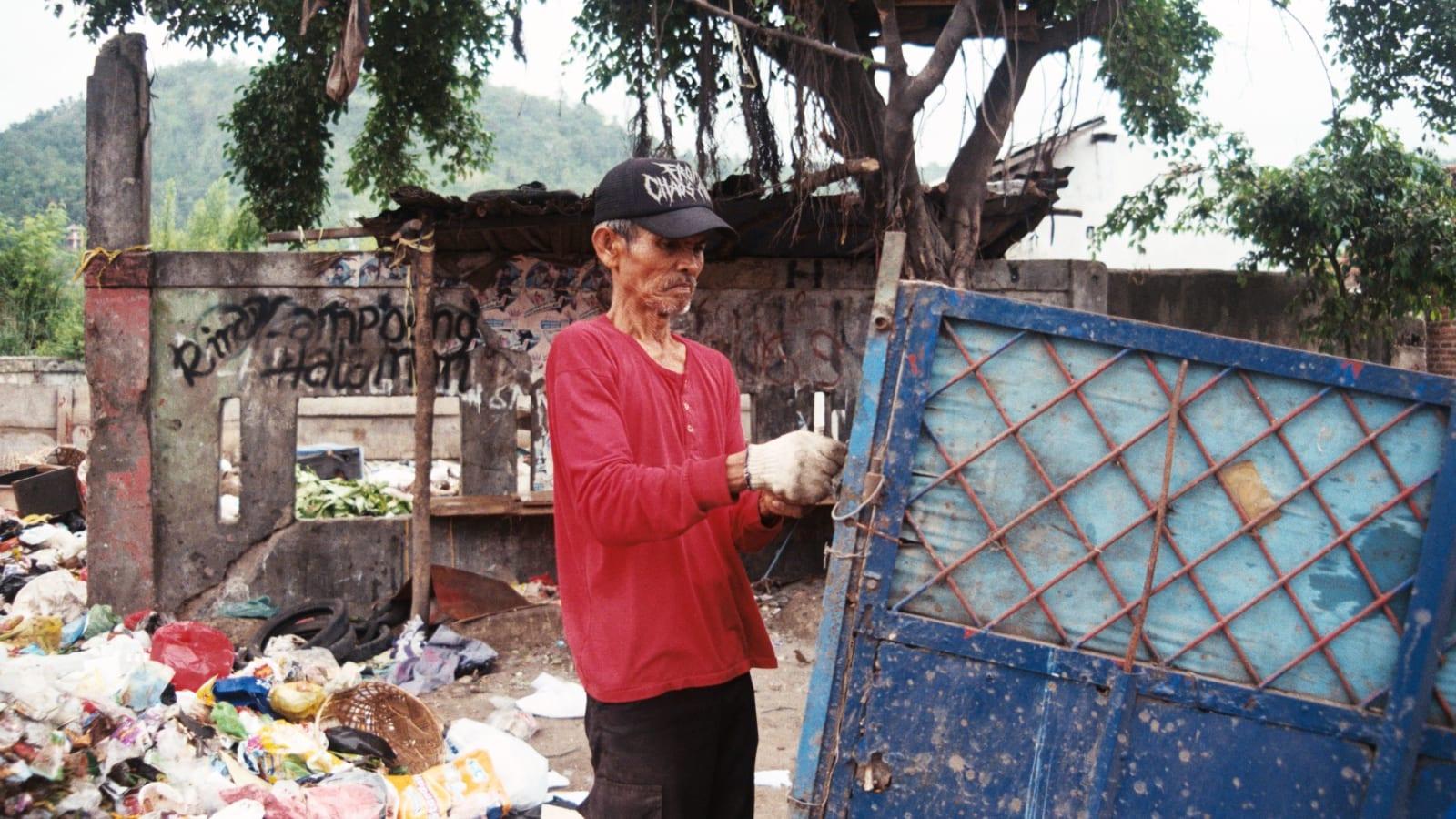
Officials estimate more than 4,000 registered waste pickers work at Bantargebang daily, moving alongside trucks and excavators to recover plastic, metal, and other saleable material before it is buried. Nationwide, an estimated 600,000 people depend on waste picking for some or all of their income, a workforce whose scale rivals many formal industrial sectors even though it operates almost entirely outside formal recognition.
Nur Wencih, a 35-year-old widow who has worked the site for two decades following her parents into the trade, described earning around 200,000 rupiah, about 12 US dollars, on a good day of recovery work. As landfill management tightens and waste is compacted and covered more quickly to control methane and fire risk, the window pickers have to recover material before it disappears under fresh cover is narrowing.
"Today they are practically racing against our excavators to grab recyclable materials. It is extremely dangerous," said Dudi Gardesi Asikin, head of Jakarta's Environment Agency, describing why the current informal arrangement needs a safer, more structured replacement rather than simply continuing as is.
This is the crux of the policy challenge Indonesia is now navigating in public: closing open dumping is unambiguously good for public health, air quality, and the climate, but the same reform changes the working conditions of hundreds of thousands of people whose livelihoods currently depend on informal access to landfill material.
Turning informal recovery into formal circular value
The more constructive framing gaining traction among Indonesian waste sector practitioners is not to protect the informal status quo, but to formalise it into the circular economy proper. Community waste bank models, of the kind championed by founders like Monica T. Anggriani, already demonstrate that organised, source-separated material recovery can pay participants more reliably and safely than scavenging an active landfill face. David Sutasurya, executive director of the environmental group YPBB, has long argued that Indonesia's waste sector needs recycling-based systems that can formally absorb the labour currently trapped in informal recovery, rather than treating waste pickers as a problem to be managed around.
The economics support that direction. Estimates cited by Jakarta's Environment Agency put roughly 50 percent of the capital's waste stream as compostable organic material and another 30 percent as recyclable, meaning up to 80 percent of what currently reaches Bantargebang could, in principle, be diverted through source separation, composting, and material recovery before it ever needs burying. Only the remaining fifth, largely non-recyclable residuals such as soiled paper products and mixed packaging, needs to go to controlled disposal at all. Realising that potential at scale would simultaneously shrink the methane problem, create a larger and more stable market for organised waste banks and recyclers, and open a formal, safer pathway for the workforce currently operating informally on the landfill face.
What comes next
The 1 August start date at Bantargebang and the other 342 sites is a phased beginning, not a single switch. Nationally, the Ministry of Environment has set 2027 as the hard deadline for regional governments to end open dumping altogether, tightening an earlier, looser 2028 target. Ministry figures presented earlier this year showed roughly 30 percent of the country's landfills had already discontinued open dumping by the end of 2025, with the remainder now under active monitoring and, where necessary, sanction.
It is worth noting that national tallies of exactly how many disposal sites exist, and how many still need to convert, vary somewhat between sources, with wire reporting citing 550 total sites and 343 in transition, while ministry figures referenced separately this year cited 485 monitored landfills nationally. The most likely explanation is differing definitions of what counts as a formal disposal site versus a registered final processing facility, and Sirkularium will continue to track official reconciliation of these figures as the Ministry publishes updated data.
Financing remains the other open question. Covering the remainder of Bantargebang's active face alone is estimated at up to 200 billion rupiah, and that is one site among hundreds now attempting a similar transition. How much of that capital comes from municipal budgets, national transfers, or blended finance vehicles will shape how quickly the reform can move from pilot sites to nationwide practice.
Sirkularium's view
For government and public institutions, this reform offers a clear template worth replicating deliberately rather than improvising site by site. Three elements stand out. First, methane capture and landfill covering should be budgeted and sequenced with the same urgency as fire prevention, since the two risks share a root cause and a shared engineering fix. Second, formalising waste picker livelihoods through waste banks, cooperatives, and structured recycler partnerships should be built into landfill transition plans from the outset, not addressed reactively once informal access is curtailed. Institutions that treat the workforce as a design input, rather than an externality, are likely to see smoother transitions and better material recovery outcomes. Third, the apparent gap between national landfill counts from different sources is a reminder that consistent, published site-level data will make it easier for regional governments, financiers, and the public to track progress against the 2027 deadline with confidence. Indonesia's waste sector has the policy direction right; the work now is in the sequencing, the financing, and making sure the people closest to the material are carried forward into its more formal, more valuable future.
Estimated composition of Jakarta's daily waste stream
Values in %
Sources
- Korea Times (AP), Indonesia plan to cut landfill methane alters trash picker livelihoods
- 1News New Zealand (AP), Indonesia cuts methane emissions, changing waste pickers' lives
- KSAT San Antonio (AP), As Indonesia cuts methane emissions, life atop a mountain of garbage begins to change
- ANTARA News, Minister sets 2027 deadline to close open dumping landfills
- Kompas.id, Semua TPA Open Dumping Ditargetkan Berhenti Beroperasi Tahun 2026
- Kementerian Lingkungan Hidup, Rakornas Pengelolaan Sampah 2026: Menteri LH Tegaskan Transformasi Total Tata Kelola Sampah Nasional